

Navigating the Silicon Heartland: Driving Conditions in Columbus, Ohio in 2026
Columbus, Ohio, in 2026 is a city caught in the exhilarating, exhausting grip of a metamorphosis. Dubbed the "Silicon Heartland," the region has experienced a population and economic explosion that has fundamentally rewritten the rules of the daily commute. If you are gripping the steering wheel on Interstate 270 right now, you already know the truth: driving in Columbus is no longer the predictable, twenty-minute breeze it was a decade ago. It is a dynamic puzzle of massive infrastructure upgrades, transit overhauls, and shifting traffic patterns.
As the city scales to accommodate its booming tech sector and expanding footprint, drivers are navigating a transition period defined by progress and patience. Here is a comprehensive look at what it is like to drive in Columbus in 2026, and how the city’s massive investments are actively reshaping the roads. Explore Horizon Driving School in Ohio, USA.
The Silicon Heartland Shift: A New Kind of Rush Hour
To understand the driving conditions in 2026, you have to look east toward Licking County and New Albany. The monumental Intel microprocessor megasite is now operational, bringing with it a gravity that has pulled commuter traffic in entirely new directions. The days of a purely downtown-centric rush hour are officially over.
Instead, Columbus drivers are experiencing heavy, multi-directional flow as thousands of workers, freight trucks, and logistics vehicles navigate the northeastern corridor daily.
The Ohio Department of Transportation (ODOT) anticipated this shift, which is why state routes and local arteries are currently undergoing historic expansions. The $47.2 million rehabilitation of State Route 16 in Licking County is a prominent fixture of the 2026 construction season.
For drivers, this means navigating reduced speeds, concrete barriers, and shifting lanes. However, it also means witnessing the real-time widening of a vital artery designed to support the region's economic engine.
The tech boom has fundamentally altered the "reverse commute," making the morning drive outbound from downtown to the eastern suburbs just as congested as the inbound lanes.
The Heart of the Beast: The Downtown Ramp-Up
Right in the center of the city lies the most infamous stretch of asphalt in Central Ohio: the I-70/I-71 split. For years, the overlapping merge of these two major interstates—often referred to affectionately and begrudgingly by locals as "The Trench"—has been a bottleneck of epic proportions.
Built in the 1960s to handle 125,000 vehicles daily, it now chokes on upwards of 175,000.
In 2026, the sweeping "Columbus Crossroads" project is aggressively pushing through Phase 3 and Phase 4 of its multi-billion-dollar overhaul. If you are driving through the downtown innerbelt this year, you are driving through an active mega-project.
Lanes are constantly shifting to accommodate the widening of the freeway to a continuous flow of up to 12 lanes.
The good news? The recently completed bridges at Broad Street and Long Street—featuring widened sidewalks, high-quality landscaping, and pedestrian-level lighting—are offering a beautiful glimpse of the finished product.
The urban avenues connecting them are actively stitching divided neighborhoods back together.
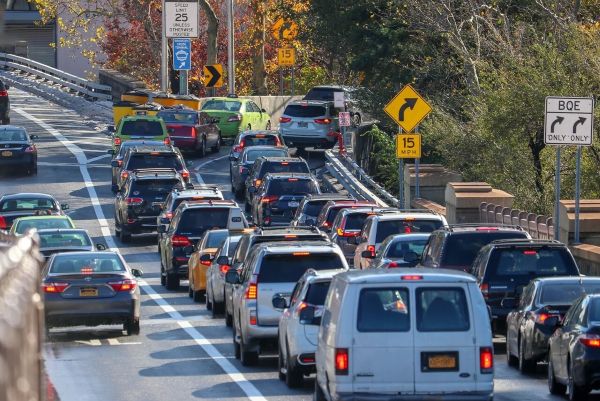
The bad news? Navigating the East Trench still requires hyper-awareness. Sudden lane shifts, exit closures, and the sheer volume of heavy traffic mean drivers must remain alert and rely heavily on real-time navigation tools.
The West Side Squeeze: I-70 Pavement Reconstruction
While the downtown innerbelt gets much of the attention, west-side commuters are facing their own daily gauntlet. Since the winter of 2024, crews have been tackling the monumental I-70 pavement reconstruction between the Madison County line and Hilliard Rome Road.
In the summer and fall of 2026, this $54.4 million project has forced a major traffic pattern shift. Crews are completely rebuilding the westbound side of the interstate.
To keep traffic flowing without full closures, lanes have been condensed and temporarily shifted onto the eastbound side. For drivers heading toward Hilliard or out toward Springfield, this means narrower lanes, absent shoulders, and a strict adherence to work zone speed limits.
ODOT's strategy of maintaining two lanes of traffic while completely rebuilding the roadway from the sub-base up is infinitely safer for workers, but it demands patience from daily commuters.
Expect unexpected slowdowns here, especially during the afternoon rush when the setting sun glares directly into the westbound windshields, compounding the tight driving conditions.
The LinkUS Revolution: Sharing the Road
You cannot accurately describe driving in Columbus in 2026 without talking about what is happening next to the driving lanes. The much-anticipated LinkUS mobility initiative has finally moved from the planning boards to the pavement.
This year marks the official groundbreaking for the West Broad Street Bus Rapid Transit (BRT) corridor, a massive step toward modernizing the city's public transit.
For drivers on West Broad, this means construction equipment is an everyday reality as the city carves out dedicated transit lanes and builds modern, ADA-accessible stations.
While the ultimate goal of LinkUS is to remove excess cars from the road and provide fast, reliable public transit, the current transition phase requires drivers to share restricted space with heavy machinery.
Similar early-stage disruptions are popping up along East Main Street and Olentangy River Road as those BRT lines advance through their final design phases.
Furthermore, 2026 sees the rollout of 37 separate sidewalk, bikeway, and trail projects across the Columbus area. The city is actively redesigning its infrastructure to feature "Complete Streets."
For the person behind the wheel, this means adjusting to a new urban grid where space is equally shared with a rapidly growing number of cyclists, pedestrians, and high-speed buses.
A Driver’s Survival Guide for 2026
So, how do you successfully navigate the driving conditions of Columbus this year? It requires a blend of technological reliance, strategic timing, and old-school defensive driving.
-
Rely on Real-Time Data
Make a GPS application your best friend, even if you know the route by heart. With ODOT managing a record-breaking $3.4 billion in statewide construction in 2026, a highway ramp that was perfectly clear on Tuesday might be completely shut down by Wednesday morning. -
Respect the Orange Barrels
The Ohio Turnpike Commission and local authorities are cracking down severely on distracted driving, especially in high-risk areas like the I-70/I-71 split and the West Broad BRT zones. Fines are steep, and the physical danger to the thousands of highway workers currently deployed across the city is very real. Put the phone down and keep your eyes on the road. -
Shift Your Schedule
The traditional 8:00 AM to 5:00 PM rush hours no longer truly exist in Columbus. They have flattened out into broader, sustained periods of heavy traffic that begin as early as 6:30 AM. If your employer allows flexible working hours, shifting your commute to off-peak times can easily shave twenty minutes off your daily drive.
Looking Down the Road
Driving in Columbus in 2026 is, ultimately, an exercise in witnessing history. The ubiquitous orange barrel is not just an obstacle to your morning coffee; it is the physical manifestation of a city rapidly growing up.
The mid-century infrastructure that is currently struggling to contain today’s traffic is actively being replaced by a resilient, multi-modal network designed for tomorrow’s metropolis.
It requires patience, a reliable playlist, and a keen eye on the road ahead. But as the new downtown bridges open, the transit corridors take shape, and the sprawling highways stretch to meet the demands of the tech sector, the promise of a connected, modern Columbus is finally coming into clear view.
The drive might be messy right now, but the destination is well worth the ride.